top of page

Greetings. Juarna is a planet orbiting Dionysus in the Formedoid galaxy. This is a documentation of the animals that live there, and a attempt at piecing together the history.
On my planet, I asked several historians, who all say that the planets earliest appearances in documented history, is 2008273926DV, or in earthly years -201823 AD. My assumption on the time of the planets formation, is -102293928827878667566445454DV
(-90000000+ AD) ago.
On 300300000030474765251616171635DV (2025 AD), I asked to participate in an expedition to a planet 1110002735572QW (362,000 miles) from my planet (Divunar). I took a Qjurnna (a form of transportation) to get to juarna, and my project began.
When I arrived on the planet, I saw that there are many unique properties of this planet. Most of the flora are very vibrant in color, being a bright Dokungin. There are many tall fungal pillars in 68% of the planet that are made out of a dense fungus. They spread their matter via small, gliding appendages that grow more pillars.
In a large area (I'm calling it Sirinaphros), there are lots of common animals I'm calling Crokimik
These are the very first thing ive seen
with 4 legs, and 2 arms, but most other
fauna have this body plan (due to a co-
-mmon ancestor). This species has a few
very specific attributes. it has very uniq-
-ue lungs, being external, and on the he-
-ad.
They are one of, if not the most common
flora eater. I also saw small, edible fungu-
-s growing off the side of a pillar. They s-
-eem to have a Gqkaanv glow. I ate one,
and it had a bitter taste, and it seemed to be mildly poisonous to me. I vomited a glowing substance, but nothing else. I took a larger photo of it from above, when i noticed a much larger animal. It has a very similar body plan to the Crokimik, but it is a carnivorous, apex canopy predator. It hides in the pillars, and leaps down from them to eat their prey. This specific Crokimik is a juvenile, and is incredibly agile. I saw the larger animal (I'm calling a Staalimik) leap from the pillar, and almost kill the Crokimik. the Crokimik ran at 2DBR (25MPH), and the Staalimik ran after it. the Staalimik used its powerful legs to leap, and get more airtime, to outrun its prey. I unfortunately saw the juvenile get eaten.
I traveled farther, and ex-
-plored the region of Mor-
-itonar. This area was ve-
-ry cold. The terrain was
a very pale scurnitch.
There were many species
that adopted unique trai-
-ts, like a thick layer of
thin fibers that protect
them from the freezing
cold. The ground is cove-
-red in some sort of scur-
-nitch powder. I go into
further research on the
substance later. When I
entered Moritonar, there
were little, to no animals in sight. The
only things I could find were large flying creatures (Im calling them Cqbaak). I believe that almost every terrestrial animal has the same ancestor, including this one. Once I caught one, it made a large screech, and I think it alarmed something. I think it alerted its predator, a very large animal I'm dubbing Chrokdilith. This animal is very large, over 10dhs (~45ft)
tall. I believe it eats both flora and flesh, because I saw it dig under the powder, and consume the plants. I believe when it wants to eat a larger animal, it uses a sharp appendage on its head to pierce the flesh and kill its prey.

image of a Crokimik

Juvenile Crokimik being stalked by a adult Staalimik
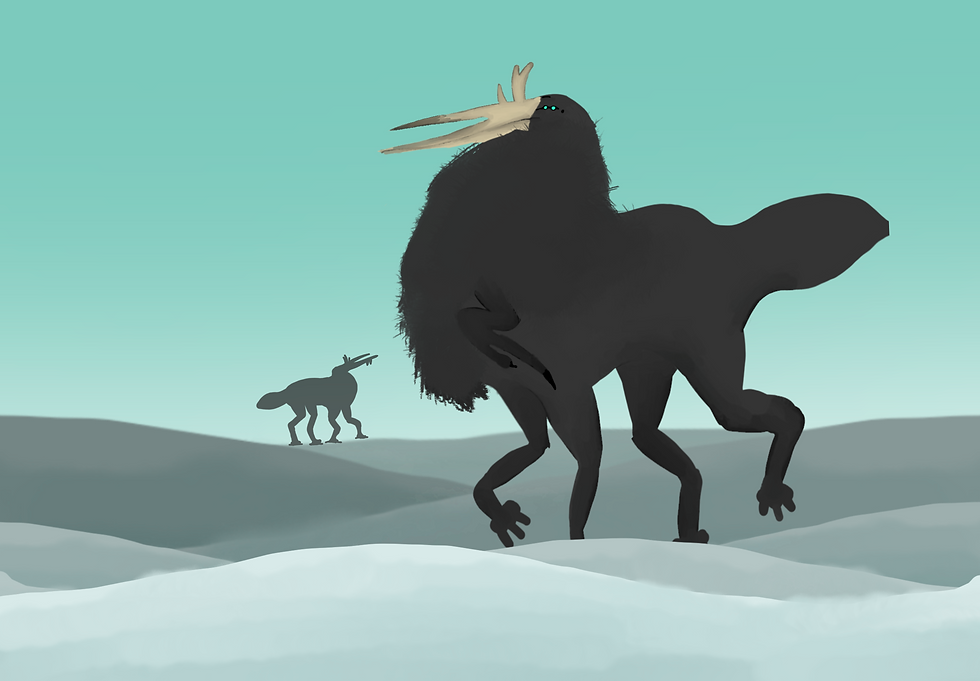
I believe the arms on this animal are effectively useless, because they are too short to do anything. I decided to leave before I get eaten, like the Cqbaak. I had to go back through Sirinaphros to get to the next region. I saw a dead Staalmik, which seems to have passed from starvation. I took a sample for later inspection. There was a large passage way from Sirinaphros to the new region, Glornis.
An adult male Chrokdilith
On the path, I saw many small creatures crossing with me. Some of them had very strong skin, almost bone like. Others were covered in similar fibers of that on the Chrokdilith. They were all traveling in the same direction rather quickly. In Glornis, there were little unique predators. The Flora eating animals are actually much larger than in
Sirinaphros. The largest of
Glornis is the Sqoorgda, being
over 5DHM (22.5ft) long, and
2DHM (9ft) tall. They seem to
break the surface of the wet
ground, to reveal very small
animals to supply food to the
other animals. This animal
seemed to evolve 6 legs,
instead of 2 arms and 4 legs,
possibly for balance. There is
a beach in this region too, but I'll make a edge
examination after I explore all the land. I traveled to Biurden, a very vast field. it seems on the surface that there's not many animals, but under the ground, lie very small animals, very similar to the ones on the path. These animals dig underground, I assume as a defense mechanism(?). In fact, before my trip ended, I believe every prey animal dug like this. I unfortunately couldn't take pictures of the small digging creatures, because couldnt take them fast enough. Im calling them Cordbaad (creature covered in fibers), Cpaamna (the armored creatures), and Cwanaap (a small semi-aquatic creature).
There is a large island to the side of Biurden, that I'm calling Surnagaar. It is a very remote island 1,500,00DHM (7,000,000ft) away from Biurden. I swam to the island, and saw there were no predators, so it is very populated.

A moving group of Sqoorgda

This island is very different from the mainland. From what I could tell, the wildlife is unusually docile. Two of the most successful animals are a flying animal (a Fraanda), and a terrestrial herbivore with the common body type (a Croontrada).
Instead of large fungal pillars, this island has extremely large, edible fruit. These fruit are 2DHM tall, and have dokungin inside color. I ate a bit, and it tasted slightly sweet, but bland. Would not recommend.
a Fraanda, and a Croontrada eating a fruit
I left Surnagaar, but stayed in the water. I saw another large island when I arrived. The Divunarian people are semi-aquatic and can swim at 5DSM (10mph) on Juarna, due to it having lower gravity. The island Jurlie has a abundance of an invasive plant, the hyndroonia. Hyndroonia plants use water from the ocean and disperse it through mist, keeping every plant alive. I will go into further depth later. There is one last piece of land that I
will explore before going into depth. At the center of the mainland has a massive mountain, surrounded in water. This mountain is 70000DHM (~315,000ft) tall. I believe it is the highest peak in the Formedoid galaxy. If I want to climb it, id have to find a different way. To my luck, there is a water fall running from the top. Divunarians can swim up current, due to us being powerful swimmers. It seems that only flying animals live on the mountain. They seem to lay their eggs at the very peak to protect them from predators, only being outmatched by predators built for climbing. These eggs are very unique from what I know. These eggs are tough, and are transparent.
I will go in depth into the eggs hatching, because I'm very curious. The mountain is covered in the same dust as seen in Moritonar. I will go into my theory on why this is later. I saw various new flying creatures on the mountain, being very visually distinct.

I was then chased off the moutain by the assumed mother of the eggs.
I havent explored every part of the planet though. im going to go in depth on this planet.
In the sea of the planet, there are many unique species of wildlife. I believe a lot of these creatures are also related common ancestor, but unlike the land, there are also sea creatures that are unrelated to the rest of them.
Fraanda eggs
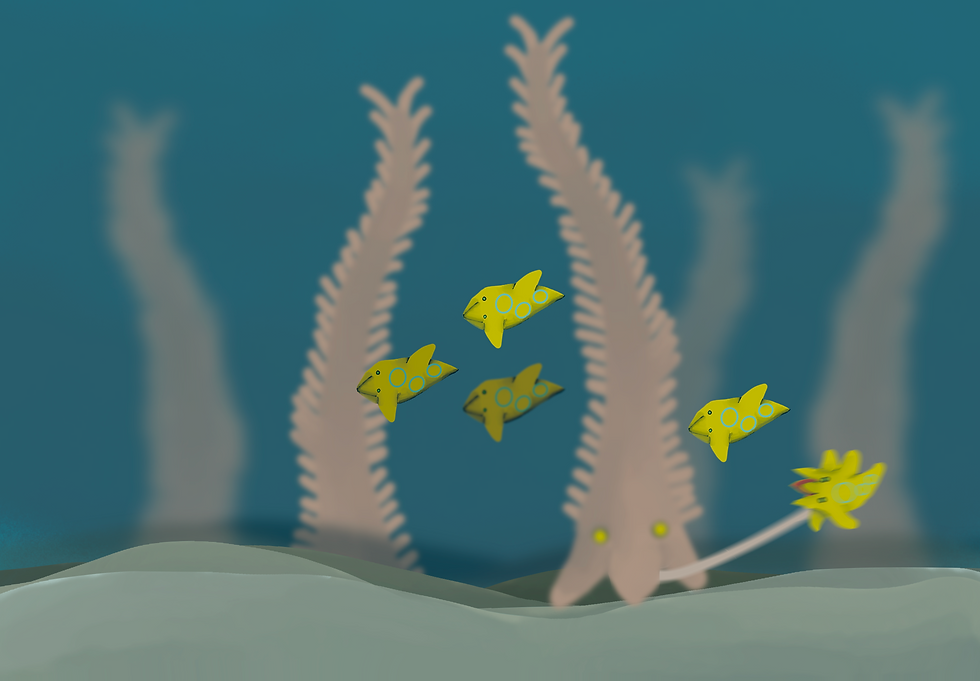
The most common body type in the oceans are small, with 4 eyes, and 4 jaws. Most of this kind of animal are plant eaters, but they have relatives who are also flesh eaters. I was taking a picture of some small wildlife swimming in groups, and I only noticed a camouflaged meat eater (a Quanngaurn) after it caught its prey (a Kawnna) when i took the photo. There are many different species of Kawnna, having different colors, different body shapes, etc.
a Quanngaurn consuming a Kawnna
There are several other ocean animals, including ones I believe evolved from land.
I believe these animals
(Steergimik) evolved from
a early Staalimik relative.
The Steergimik do not
have 2 manipulator arms,
and instead have a small
membrane that are used
for maneuvering. These
creatures have a very
unique head, having a
very long crest used for breathing under water. On the shore of Surnagaar, there are very small creatures (pok). They are so small, they can only travel with the air.

3 Steergimik

They spread their wings, and with their weight, they let the air take them. They are very common on Juarna, but they are never seen together. From what i could tell, they are surprisingly meat eaters.
they consume the corpses of decaying animals.
A Pok taking flight
There are dozens of other living animals on this planet that I am yet to list, but there are likely hundreds of extinct species. These species can confirm, or disprove all my previous theories, which is why I'm going into depth.
The first topic I will discuss, is the very strange dust that covers moritonar. There is a fact that I neglected to mention, being the fact that the mountain has the same dust. I dug into the mountain, and discovered a mineral not present on the rest of the planet. It seems to be a more solid version of the dust. There have been moons that our kind have colonized, and they have very similar dust. I believe that the planet was struck by an orbiting moon in its infancy, forming the mountain, spreading cold to moritonar, and spreading the dust. This theory is further confirmed by ores commonly found on moons being present in the mountain. I assume that the moon crashing into the planet caused a mass extinction event, that killed almost all life. this theory is backed up by fossils being found under the mountain. I will go into further depth on animal history later. From what I could tell, a lot of the modern flora evolved after the impact. Strangely, it seems that the impact helped the environment, making all of the flora and fauna much more impervious to many diseases, leaving almost the entire planet completely disease free. I believe they evolved to survive the dust and made their immune systems a lot better.
There are many extinct species, that all died in different ways. Some out competed, most evolved and died out.
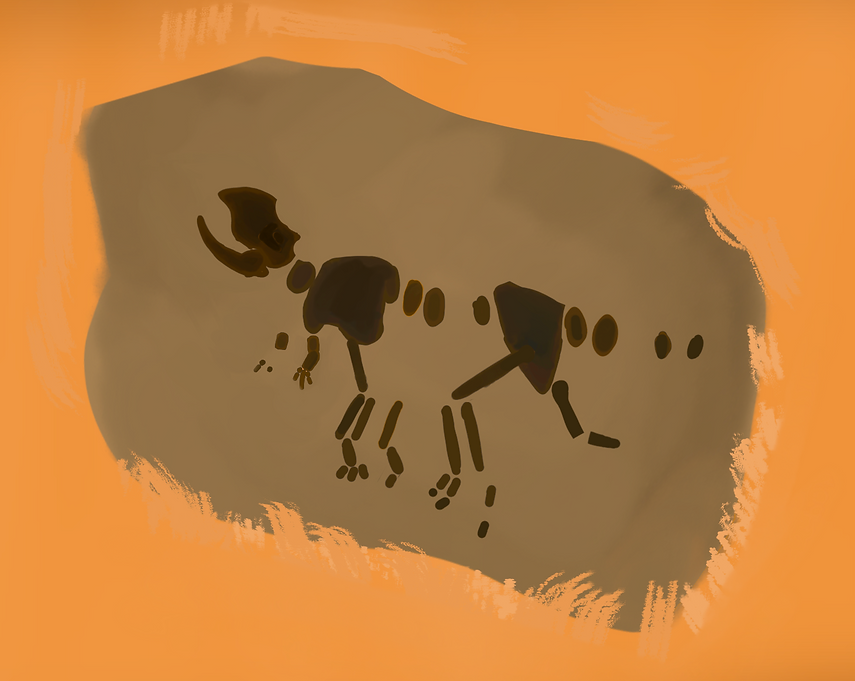
I found a fossil that confirmed my theory of most terrestrial being related. The fossil has 6 limbs (much like the modern animals), and small holes below the eye socket, that all of them share. I dub this category of animals the Mikalozoid. I suspect that this animal (Paakimik) is a very successful meat eater, because I saw many fossils of this animal, some consuming smaller animals. These fossils are common near the mountain.
A fragmentary Paakimik fossil

In the ocean, there were small aquatic animals that later evolved into most sea animals. It has its characteristic 4 jaws, which confirms they survived, and evolved. I believe these animals arrived after the impact, because their descendants have much weaker immune systems compared to the other animals.
I believe that almost every Paalkimik died when the impact happened, only leaving ~12. But somehow, they repopulated and now they reign the planet.
I dub this animal a Kerana. These are the only fossils I could find, but it is highly likely there are hundreds more.
A fragmentary Kerana fossil
The final topic that I'd like to cover (before my attempt at the history) is a very unique natural phenomenon. When I was leaving the planet, I barely saw any animals. I believe it is because of a phenomenon that happens once a year, and it's when all the hydroonia plants die, and a wide drought occurs. From what I can tell, all prey animals dig underground for a long time, while all of the predators become much more aggressive. I believe this is a counter to predator overpopulation. This also explains the Chrokdilith diet.
Overall, this planet is extraordinary. It is a wonderful planet, with amazing animals. I would love to go back at another time. Thank you.
--Dqaanjur
bottom of page